Maryrose Lyons has spent 25 years helping firms through every wave of new technology, and generative AI is the biggest she's seen. These days she runs the AI Institute, working alongside construction, engineering, architecture and QS teams across Ireland, the UK and EMEA, and has upskilled more than 2,800 professionals along the way. She's the voice behind the ChattingGPT podcast. Each bi-weekly edition pairs a piece of her thinking on AI at work with the latest episode. Pull up a chair with more than 5,800 readers.
No teeth, no budget
|
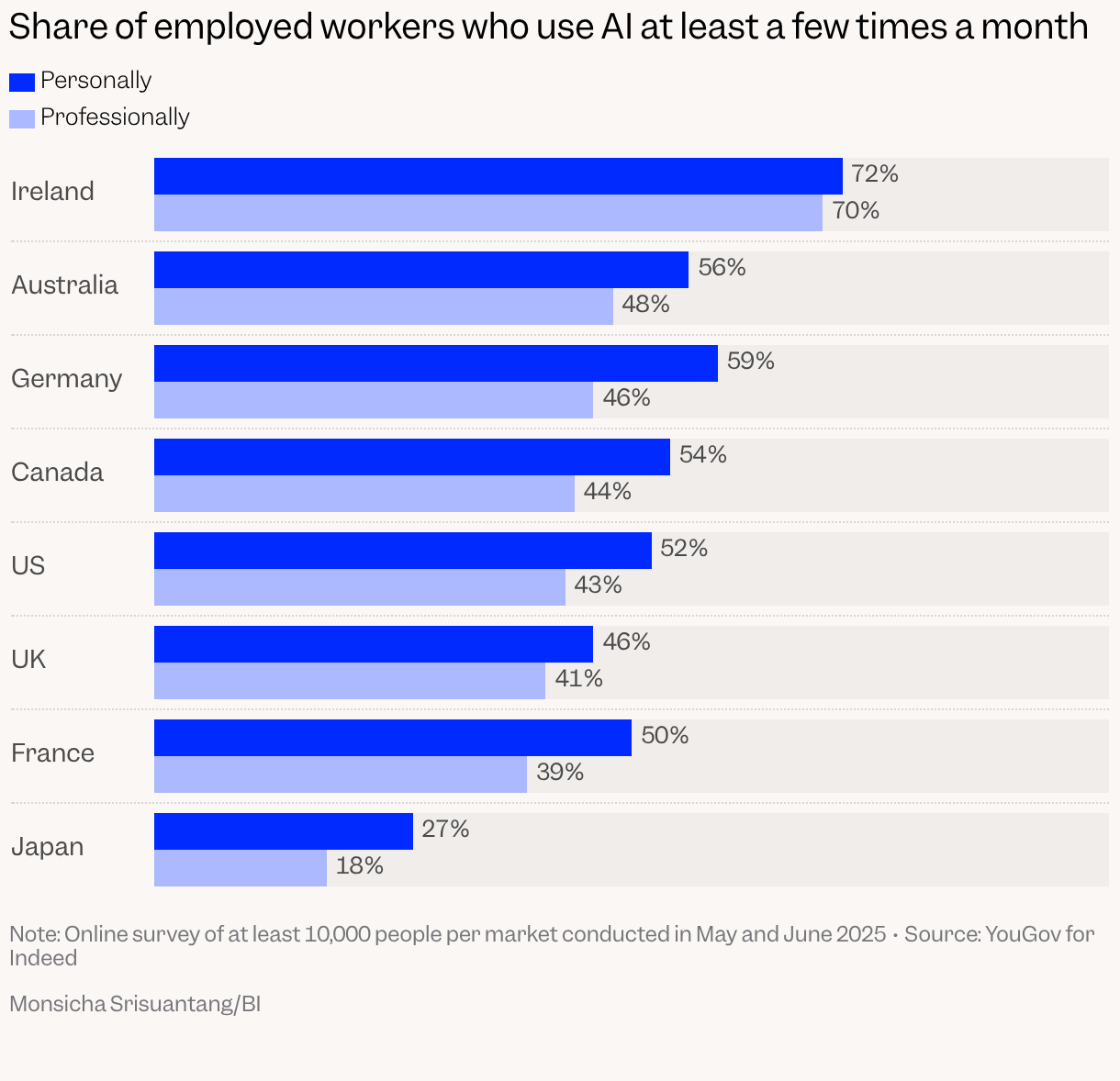
Hi Reader! Tomorrow Ireland takes the Presidency of the Council of the EU, and we do it from a position most countries would envy. We top the table for AI use at work and outside it. The Business Insider chart below puts us at 72% personally and 70% professionally (in 2025), ahead of Germany, the US and the UK. We host the European headquarters of most of the firms building this technology. We have a domestic policy push around AI and digital regulation. Add the Presidency and you have a country that could genuinely set the pace on how Europe governs AI. And yet, that's not going to happen.
Set this again the backdrop of what's happening in the US where the tech bro's who were calling out the EU AI Act as 'red tape from a continent that builds nothing', are now squabbling amongst themselves as to whether it's good to have regulation or not. A recent Axios piece had investors and tech executives calling for clear rules rather than ad hoc access decisions which is exactly what they are getting from Washington right now: the Trump administration has blocked the full release of GPT-5.5. Which makes what we did next all the more frustrating. On 17 June the Irish Government published the Regulation of Artificial Intelligence Bill 2026, the Irish implementing law for the EU AI Act. And we reached, as we always do, for a distributed model, again. A distributed model. Again. We do love a distributed model in this country. We have 70 Skillnet networks, all running their own tenders, their own rules of engagement, their own vendor approval proceesses. We have so many hubs and supports for entrepreneurs that we need a website to keep track of them all, and yet actual entrepreneurs like Eamonn Leonard will tell you on the record that most of them achieve very little. So forgive me for flinching a little bit when we apply the same scattergun approach to something as important as AI Act enforcement. What the Regulation of AI Bill has done is to leave supervision for AI sitting with the existing sectoral authorities (financial services, medical devices, media, consumer protection). The new AI Office becomes like the national enterprise hub - a website for keeping a register of prohibited practices, high-risk systems and serious incidents. It holds no enforcement power of its own. So instead of one central regulator with teeth and the nerve to use them, we get several, each a little thinner than the last. Two problems with this. Recruitment. Every one of those bodies is going to have to become fluent in every aspect of AI, and keep pace with a technology that does not wait. Government recruiters will have to find not one person for every role, but one for every existing regulatory body. What's the quality going to be like? No teeth, and no budget. This is the worst. There is no money behind any of this. Originally there was going to be a levy so that regulators could recover the cost of their expanded mandate. But even that levy is gone. The authorities are now being asked to supervise high-risk AI from existing budgets. F***ing Ridiculous. A cynic might wonder what has passed between February and June, in a country where most of Big Tech keeps its European address? For them, it's business as usual. No interference from the State. Job well done to all the lobbyists. The EU got the big idea right. The AI Act was visionary and first of its kind, regulation as a way to give people and firms guardrails to work within rather than a brake to slow them down. That instinct, that you can set the pace and protect people at the same time, was the correct one. But noble EU ideas have a habit of being chipped away at by individual Governments, and Ireland is where the chipping starts. Our legislators have an outdated idea of what regulation is for: they believe it's for protecting the way that things have always been done. In an AI era that is the wrong assumption. The regulation needs to give people and firms the nerve to move, with guardrails that travel at the same speed they do. That assumption, that caution and progress pull against each other, is exactly what this week's Chatting GPT guest takes a hammer to. Check it out. This week on ChattingGPT: Dr. Craig KaplanThis week: Dr Craig Kaplan Dr. Craig Kaplan has been building AI since the 1980s — he earned his doctorate at Carnegie Mellon alongside Nobel laureate Herbert A. Simon, one of the people who named the field. He now gives away his designs for safe super intelligence at superintelligence.com. Everyone is arguing about when AI will match human intelligence. Craig says that is the wrong thing to watch. What comes after, a superintelligence a thousand times sharper than the brightest person alive, is arriving faster than anyone is ready for. And the belief that safer has to mean slower is simply wrong. His answer is not to slow things down. He describes a democracy of millions of AI agents, each carrying a real person's values, checking each other in the open, rather than one black box none of us can see inside. 🎧 Spotify Open Training: July 2026Summer Special at AI InstituteOur Copilot Cowork course has had more updates than Ireland has distributed models, and ours actually ship. Starts on 16 July, which is two weeks away. Practical, hands-on, and built around where you actually are with AI right now. While the competition is lounging by the pool, you could be stealing a march. Around in July? Good. Three Tuesdays in July. This is the most up-to-date course on Copilot there is, featuring Cowork and all the latest additions that are making Copilot a very exciting product at this moment.. Secure your spot → Browse all public courses >>Yours, in search of a regulator with teeth 😬 AI Institute |
Maryrose Lyons, Founder of the AI Institute
Maryrose Lyons has spent 25 years helping firms through every wave of new technology, and generative AI is the biggest she's seen. These days she runs the AI Institute, working alongside construction, engineering, architecture and QS teams across Ireland, the UK and EMEA, and has upskilled more than 2,800 professionals along the way. She's the voice behind the ChattingGPT podcast. Each bi-weekly edition pairs a piece of her thinking on AI at work with the latest episode. Pull up a chair with more than 5,800 readers.
Hi Reader! An architect friend asked me something over coffee a few weeks ago and I still haven't managed to put it down. If AI halves the hours she spends on a project, does that saving go back to the client? Or are they paying her for the skill? She's well ahead of most in her use of AI, she's just asking the uncomfortable question: the better she gets, does that mean invoicing less? Or does it mean invoicing more - more clients, and a premium for being the practice that delivers faster?...
Hi Reader! Someone asked me to ring them back in half an hour last Friday. So I did a few small jobs first, felt the time was up, reached for the phone, and only fifteen minutes had passed. Half an hour's work done in fifteen, and my body clock was still reading thirty. This is time being compressed. Funny at the time. Less funny by Sunday, once I'd added it to the tiredness, the short fuse and the broken sleep and realised I was closer to burnout than I'd like to admit. Not there yet. Caught...
Hello Reader! By the end of four Tuesday mornings you will be drafting client reports from raw meeting notes in minutes, and you will know exactly what you can and cannot put into an AI tool without creating a problem for yourself. That is what Core AI Skills is for. The autumn cohort starts on Tuesday 15 September. Most people arrive a little nervous. That is normal, and it tends to be the ones who arrive nervous who get the most out of it. What you leave able to do Turn raw notes and...