
From the AI Institute newsletter
From tender to handover, AI your team can stand over
Every second Tuesday we write about what we're seeing in engineering, architecture, QS and construction firms. It comes from training more than 2,800 people and from our guests on ChattingGPT. One opinion per issue, and I'll stand over it. Not salesy.
Featured
How Sisk runs AI across 3,000 people (without losing the humans)
What does AI at 3,000-person scale look like inside a traditional contractor? Charlie Corcoran, Head of Technology, Architecture and Data at Sisk, on building it with the workforce rather than around them.
Catch up on earlier issues
Sort by your patch, or by how work itself is changing.
Is it time to stop pricing time?
If AI halves the hours on a project, who keeps the saving? Maryrose works through hourly, fixed and outcome pricing, then hears from Dr Atif Ansar, who argues time is scarcer than capital and that contracts could guarantee a maximum time rather than a maximum price.
Can we talk about compression burnout?
Denser hours, fewer pauses and a tiredness that does not match the timesheet. Maryrose names 'compression burnout' and explains why she is building pauses back into her week on purpose. Plus Stephen Redmond on why AI adoption is a people and behaviour change that should not sit with the CIO.
Your competitor can report you for this
Two documents leave your office on a Friday, both drafted with AI. A private client report is fine. A public consultation statement for a council scheme now needs a visible 'AI-assisted' label under the EU AI Act, and a rival bidder can report you if it is missing. Where the line sits, for bid, QS and design teams.
A model that understands buildings
Is Google's real prize a world model that understands physical space? What simulation could mean for design, site logistics and facilities management, and why firms should put AI to work on bids, reports and compliance now. Plus Maryrose talks MEP engineering with Endra founder Niklas Lindgren.
The deadline that didn't move
The high-risk deadlines moved, but Article 50 of the EU AI Act still applied from 2 August. Maryrose explains who must disclose AI-generated text, when, and how review by a named person removes the label duty. Plus change specialist Karen Lewis Enright on the human side of adoption.
What RICS made non-negotiable
James Garner, Head of AI at Gleeds and a Fellow of RICS, sat on the working group behind RICS's first responsible-AI standard, which in March made AI literacy non-negotiable for every chartered surveyor. His warning is blunt: firms are funding AI strategies but not the capability to use the tools, and the risk now sits in that gap rather than in the technology.
No teeth, no budget
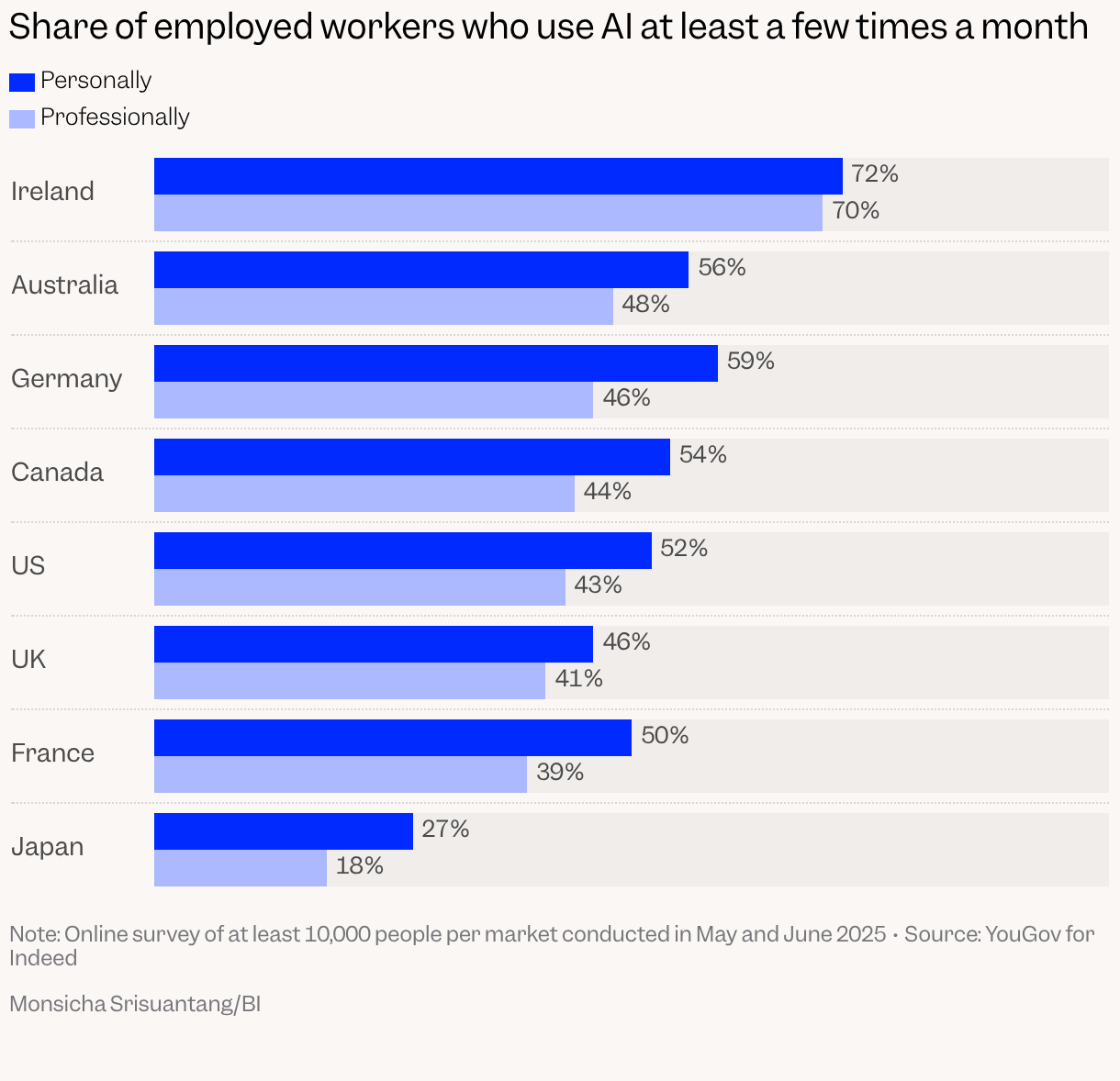
Ireland tops the table for AI use at work, yet its new Regulation of Artificial Intelligence Bill spreads enforcement across existing sectoral regulators with no central enforcer and no dedicated funding. What that means for firms. Plus Dr Craig Kaplan on why safer AI need not mean slower.

What about me?
A week of Anthropic headlines, from Dario Amodei's essay on regulating frontier models to Fable 5 being switched off by a US export directive, makes the case for AI sovereignty and local models. Plus a practical guide to getting started with Claude in Chrome.

Why I'm ditching the 20-minute call
Why the annual AI adoption research into architecture, engineering, QS and construction firms is moving from 20-minute calls to voice AI, with Prime Directive collecting answers by phone or WhatsApp voice note.
What's happening in Brussels and Beijing
EU legislators have pushed the AI Act's high-risk deadlines to December 2027 and August 2028, while the US and China prepare to discuss AI safety without Europe present. What the delay means for Irish and UK firms, plus Joe Toscano on AI search and lessons from China.
You're probably using the wrong model for most things
Token limits, rising compute bills and cheaper models such as DeepSeek V4 point to one habit worth building: match the model to the task. Frontier models for hard reasoning, smaller or local ones for routine work. Plus Vistatec CMO Simon Hodgkins on trying small things properly.
The annoying thing about Claude Code nobody talks about
Claude Code is brilliant and slightly off-putting: a terminal, API keys, a setup that feels like a wall. Past the wall, Maryrose automated the entire podcast production process in a couple of hours. The honest version nobody tells you.
Pints, petrol and prices
The Guinndex began with a question nobody was answering: what does a pint actually cost now? Matt Cortland and John Fleming built the answer with AI agents for the price of a night out, then pointed the same method at fuel.
I'm feeling it too
A low-grade overwhelm as AI agents and tools like Claude Cowork arrive, and a harder question: who owns an agent built by non-technical staff, and who answers for it? Plus Sean Blanchfield of Jentic on why agents should prove themselves in a sandboxed digital twin first.
Ireland's AI moment: ideas from builders who've done it before
Energy infrastructure, data centres and the future of professional services, in one bracing St Patrick's Day conversation with tech founder Sean Blanchfield on where Ireland goes next.
Why AI isn't making work easier (and what I'm doing about it)
Vibe working is fun and exhausting. Responding to a Stanford study on AI and workload, Maryrose shares her experiment with rebalancing weekends, reclaiming Fridays and booking time away after big pushes. Plus digital anthropologist Lollie Mancey on friction, AI companions and making space for people.
Why I cancelled my ChatGPT account
After years of treating every AI account like a favourite child, Maryrose cancelled ChatGPT Pro over a bank holiday weekend. The business case, the ethical one, and why the money followed the values.
How Sisk runs AI across 3,000 people (without losing the humans)
What does AI at 3,000-person scale look like inside a traditional contractor? Charlie Corcoran, Head of Technology, Architecture and Data at Sisk, on building it with the workforce rather than around them.
Engineering time machines: Sharon Richardson on AI and the future of cities
Sharon Richardson, AI Lead at 155-year-old engineering consultancy Hoare Lea, calls AI a time machine: weeks of modelling compressed into minutes, with the hours won back going into design. Also the skills gap, sustainability, and what cities could look like by 2035.
Space: the next frontier
World models predict what happens next in physical space: upload a building design and get a 3D version back, or feed in site footage and the model reads movement and context. Fei-Fei Li, Yann LeCun and digital twins, plus VR training pioneer Geoff Allen of Mersus on ChattingGPT.
Why leaders freeze on AI (and how to break through)
Your people are already using AI, with or without sign-off, and often unsafely. Stephen Redmond on why leaders stall, why literacy has to be led from the top, and the shift from overwhelm to curiosity.
AI thinks it can die, and markets can't price intelligence
Christmas reading for the curious: Amanda Askell on Claude's character and model welfare, the essay 'The Last Economy' on intelligence as the new source of economic value, and Maryrose with Emma Marlow on why the team turned bullish on Copilot.
The problem with provocative statistics
That MIT report claiming 95% of companies see zero return from GenAI rests on a small sample and an undefined idea of return. Five practical steps instead, starting with training people first and banking one small win, plus Beau Warren on ChattingGPT.
Buried by summer: why AI task forces fail
The tool parade, the metrics mirage and pilot purgatory: why AI task forces fade by summer, and the case for business-first training with mixed cohorts. Plus transformation consultant Stephanie Prenderville on ChattingGPT, looking back from 2030.
Get this in your inbox
What it’s like working with AI in the built environment, from someone rolling it out with engineers, architects and QSs. Every second Tuesday, one piece of thinking and the latest ChattingGPT podcast episode.
